
Participating in medical relief activities in Africa is certainly a profound experience. There, we faced various challenges such as a lack of medical resources, high incidence of diseases, and harsh environmental conditions. At the same time, we also felt the significant help our medical knowledge and skills have provided to the local people, as well as the positive impact on their lives.
During this event, I encountered patients with knee injuries causing hematoma, patients with heel abscesses, and villagers lining up demanding joint injections. I didn’t expect the skill of joint injections to be so crucial, and I’m grateful that the intensive training during my specialization was not in vain. If I have the opportunity to participate again, I will prepare more injection medications, syringes, needles, disinfectants, and medical equipment. Due to a lack of sufficient syringes, I could only pour out the extracted joint fluid and pus into cola cans and paper cups. The local resource scarcity is truly heartbreaking. Every time I tell my patients that they need to go to the local hospital for further treatment and follow-up, my translator partner bluntly responds that they don’t have money and won’t go to the hospital, leaving me at a loss for words, and I feel particularly pained.
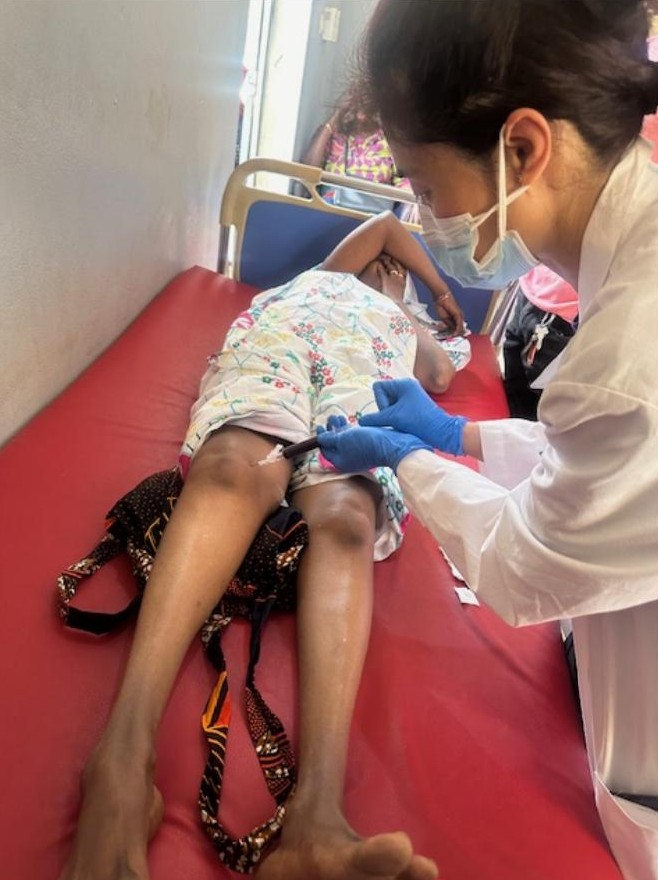 Taking fluids out from an inflamed knee of a villager .
 Pouring out the fluids taken from the villager’s knee into empty cola cans.
What impressed me the most was a woman who suffered from rheumatoid arthritis, but the local medical resources were limited. She went to several hospitals, but none could diagnose her condition. Her son told me that during her flare-ups, she needed him to carry her to the bathroom. The repeated flare-ups led to joint deformity, making it impossible for her to walk, which is absolutely unacceptable in the area where I work in the U.S.. Because we have better medications in America, I tell my patients that if they receive timely treatment and follow-up, they can continue any work and exercise they did before becoming ill. But, in such a resource-poor environment like Senegal, I feel the need to learn how to provide the most effective medical services under limited conditions while seeking innovative solutions to address resource shortages. Under the leadership of Dr. Jun Xu, I believe our medical team will be able to better serve the people of Africa.
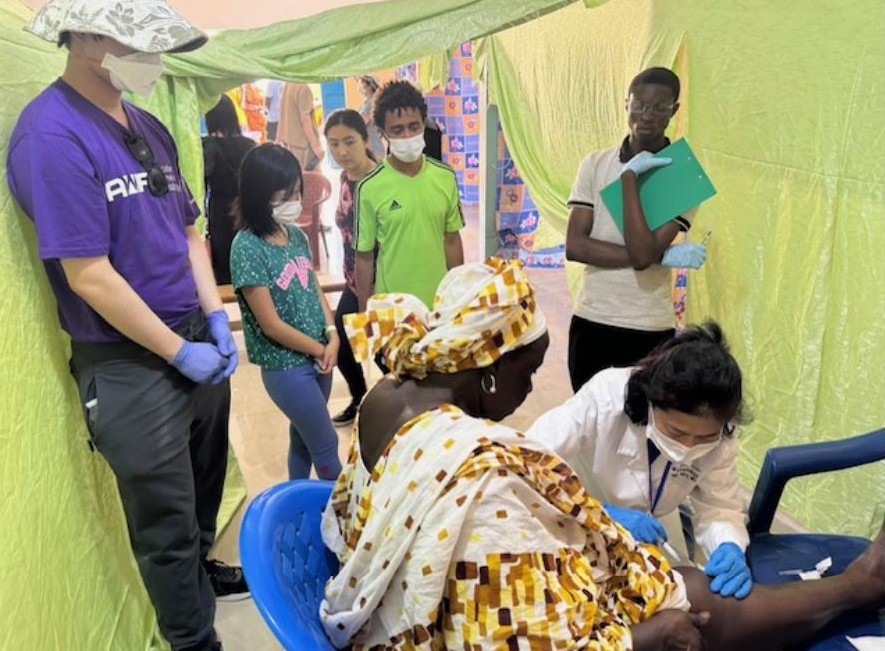 Giving injections to a villager’s inflamed knee to ease her pain.
My son, Tony Lam, was also fortunate to participate in this African medical team. He told me that this experience have a profound impact on his future medical career. The guidance from Dr. Jun Xu and the story of Dr. Faye made him rethink the meaning of being a ‘doctor”. This experience has deeply ignited his sense of mission to pursue a career in medicine!
He learned a lot about taking medical histories, physical examinations, diagnosis, and treatment from the supervising doctors, Drs. DK, VK Nguyen, and Zhang. He also sought to learn various joint injections and exchanged the knowledge and skills he gained with other volunteers. Such experiences not only showcase his humanitarian spirit and sense of responsibility but also provide invaluable practical experience and insights for his future medical career. He can combine his experiences with the medical team in Africa with what he has learned to better understand the practical significance of medicine and develop care and empathy for patients. Participating in the medical team in Africa also demonstrates his leadership skills, teamwork abilities, and adaptability— qualities that medical schools value. At the moment Tony was admitted to the David Geffen School of Medicine at UCLA. I couldn’t help but reminisce about that hot March in Senegal, when he assisted local healthcare workers in health education at a rural clinic in Africa. The land of Africa, the teachings of Dr. Xu, and the story of Dr. Faye taught Tony that medicine is a language and also a commitment, and it is this initial intention that guided him toward the halls of medical school.
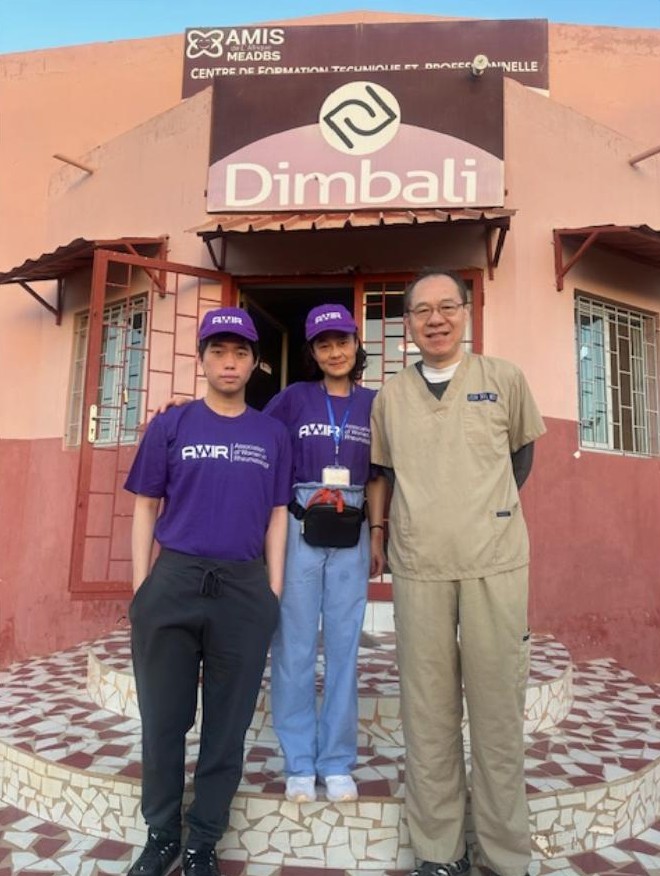 My son, Tony Lam, with me and Dr. Jun Xu.
In the medical support activities, I collaborated with doctors from different professional backgrounds, engaging in pleasant communication and assistance. Other volunteer doctors and and I divided the work to teach the youth, allowing our children to learn professional theories through practice.
In addition to our work in the medical field, we have also established a deep emotional connection with the local people. Their courage and resilience have given us great encouragement, making us cherish every little happiness in life even more. Participating in the Africa Cries Out activities not only provides medical assistance to the people of Africa but also allows us to gain profound life experiences, broaden our horizons, and increase our knowledge, enriching our lives immensely. Thank you again for this valuable learning opportunity!
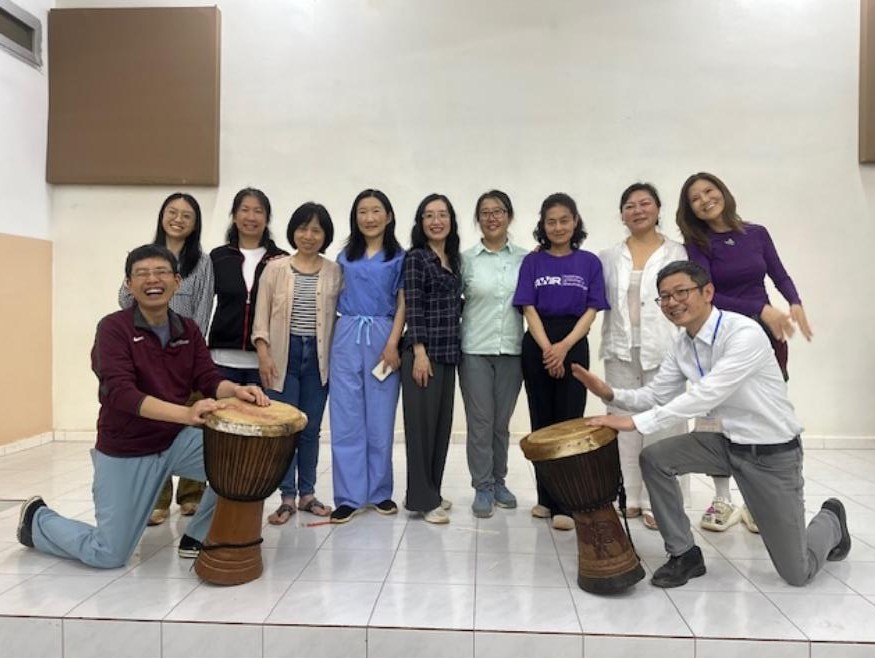 Building friendship and collaboration with other volunteers.
About the Author:
Ying Wu, M.D.
Chief, Department of Rheumatology
Palo Alto Medical Foundation
Mountain View & Los Gatos, CA
*************************************
If you are moved and willing to support our African ministry, please write a check to Africa Cries Out and send it to Jun Xu, MD, 1171 E Putnam Avenue, Riverside, CT06878, USA. You will receive a tax-free receipt recognized by the IRS.
Online Credit Card Donation: https://africacriesout.net/ (credit card company will charge a handling fee)
Zelle: Africacriesout@gmail.com
Our team solemnly declares that 100% of your donation will be used for the people of Africa, and we do not get even a penny of administrative fees.
Jun Xu WeChat: jun9174343767
Email: Africacriesout@gmail.com
Public WeChat account: LifeExploring (人生天路)
Web page: https://africacriesout.net
Editor: Doris Cruz