
A little girl stumbled towards me in grass-woven sandals crunching the loose gravel beneath her. Smiling, she raised a wooden stool, motioning me to sit upon it. Her juvenile rheumatoid arthritis did not impede her from offering a kind gesture to a familiar face. Although I had been in the Fatiga Leprosy Village just days at this point, I felt honored to sit alongside the physicians and villagers congregated in prayer under the central village tree. Together, we challenged the notions of otherness or lack of belonging that terms like ‘leprosy’ conjure.
Together, we found how medicine is but a sacred exchange between two mortal vessels. We prayed under that tree but the faith that took anchor in me was in the life-affirming and kindness of becoming a physician.
 Learning how to assess a patient’s knee.
Looking back, that girl’s smile and starry-eyed expression as I took her patient history reminded me of the nights I peered into my mother’s study room from the dark hallway of my home, squinting my eyes to adjust to the bright lights. It was long past my bedtime, but the curiosity at what routinely kept her awake compelled me to find out. Knowing that I would not leave without an answer, my mother pointed to a collage of atypical shapes and symbols, overlayed with bright neon yellow stripes. “This is a shoulder. The supraspinatus, subscapularis, infraspinatus, and teres minor make up the rotator cuff so you can move your arms like this” as she flailed lightly.
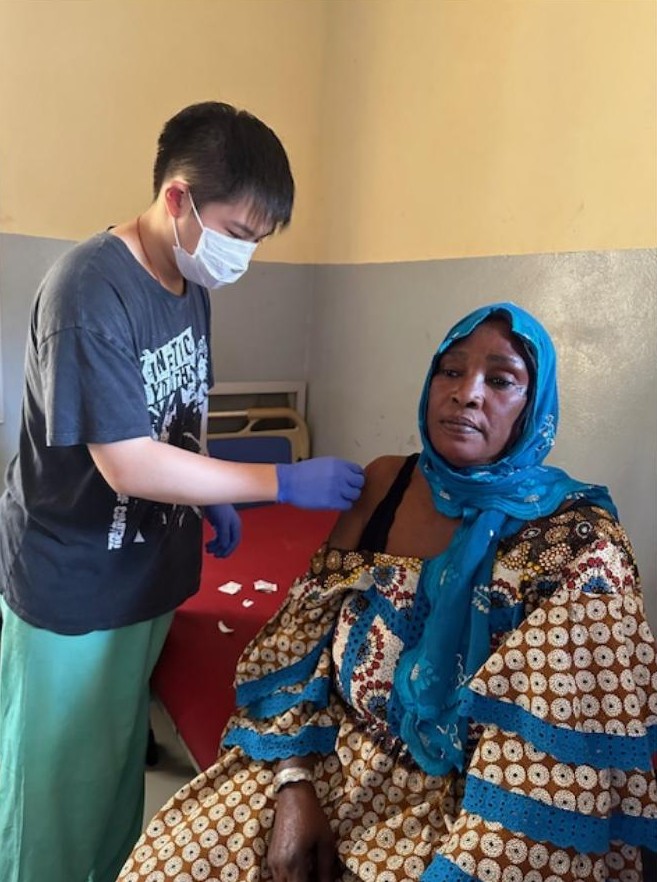 Learning how to assess the shoulder.
With any pockets of free time, I would go straight to my elementary school library for anatomy books, cobbling together impassioned discussions of my simple, naive findings at the dinner table. Years later, my immigrant mother, now a rheumatologist, revealed to me how uplifting our conversations were for her as a motivator to pass her medical licensing exams. Returning my gaze upon the canopy of the Fatiga tree, I thought about how uplifting and motivating that little girl’s gesture of kindness felt. Both experiences became guiding stars for my purpose to bring diverse perspectives to culturally aware care.
While my experience in Africa clarified my interest and purpose in pursuing medicine, it was volunteering at a VA Hospital during my undergraduate years at UC Berkeley that taught me how integral identity is to the possibilities of healing. When transporting veterans after their surgeries, I recognized how powerful reading non-verbal cues and inviting authentic conversations are to fostering quality relationships. During every patient discharge, I would pass by a 3D model map of the hospital campus the size of a pool table in the front lobby. One day, one patient marveled at the model, “Wow! Where can I get one?” His impassioned curiosity after just a couple gravely words during time with use for knee replacement surgery hit me as an unexpected surprise. I shared with him how hobbyist 3D printers are cheap online and that even libraries nearby offer a couple free prints per visit. By chance, sharing my passion in 3D printing, which stemmed from my experience on my high school robotics team, bridged his longtime hobby in building model ships and planes to form an unexpected, but significant connection. From there, I learned about his struggles with identity transitioning from military to civilian life, which prompted me to relay resources with the VA social work team for him to seek counseling for mental health and transitional assistance.
This moment taught me how our self worth and value are wrapped up with societal notions of identity and what we do. I aspire to practice medicine that physically heals but also addresses all the wounds that come with the emotional and psychological load of illness, disease, and injury.
Inspired by my connections with veterans, I pursued research at the VA, designing 3D printed assistive technology for patients recovering from stroke, and at my university, studied the human motor learning system for patients with cerebral ataxia and Parkinson’s disease. Through trial and error, I collaborated with physical therapists and patients to develop a customizable wheelchair gear to relieve hand strain of recovering stroke patients. While researching motor learning, I met patients frustrated with their lack of command over their body movements and yet, most gave their personal time to participate in conferences and these research projects to advance the field. Both sets of patients who gave so much of who they were while at their lowest taught me that medicine is a collaborative, selfless community that cares for today’s patients and advances our efforts for tomorrow’s. This unique dynamic of reciprocal growth attracts me to medicine and remains a tenet that I aim to contribute to my studies at medical school.
Medicine, at its purest form, resembles the sacred tree in Fatiga where physicians, students, and community members sit side by side—sharing stories, perspectives, and a common purpose. It’s this spirit of collaboration and service that I carry with me as I prepare to begin my journey at the UCLA School of Medicine. Among the many influences that have shaped this path, the enduring legacy of Dr. Faye—who sacrificed his life to care for those most often forgotten, patients battling poverty, leprosy, and stigma—left a profound impression on me. Though he passed away before I arrived in Fatiga, his presence lingered in every word spoken about him, in the care systems he helped build, and in the dignity he restored. His story reminds me that medicine is not just about healing bodies—it’s about standing with the vulnerable, listening with empathy, and choosing service over comfort. As I look ahead, I carry Dr. Faye’s example with me, ready to grow into the kind of physician who serves with purpose, humility, and an unwavering love for humanity.
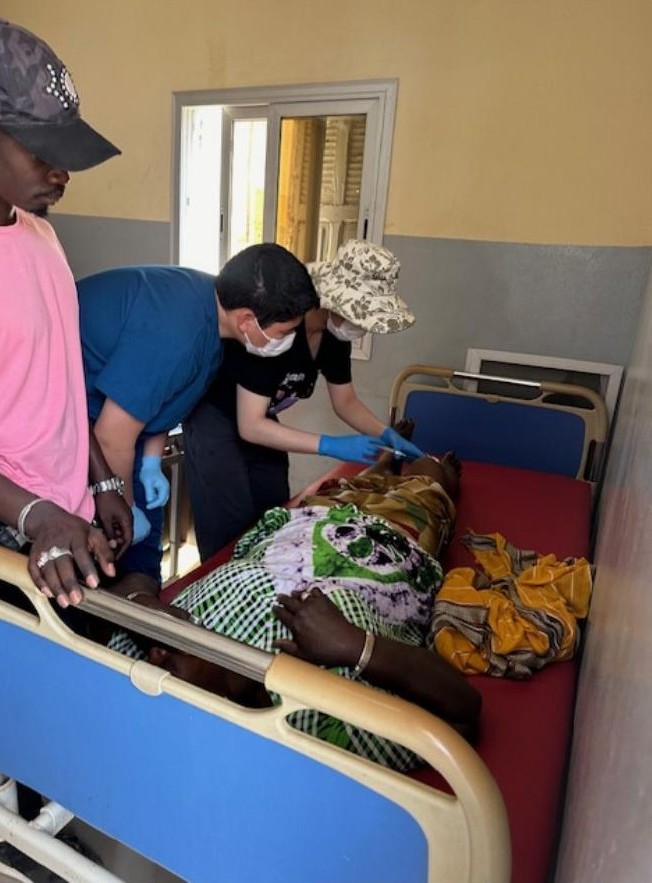 Learning how to give knee injection from my mother, Dr. Ying Wu.
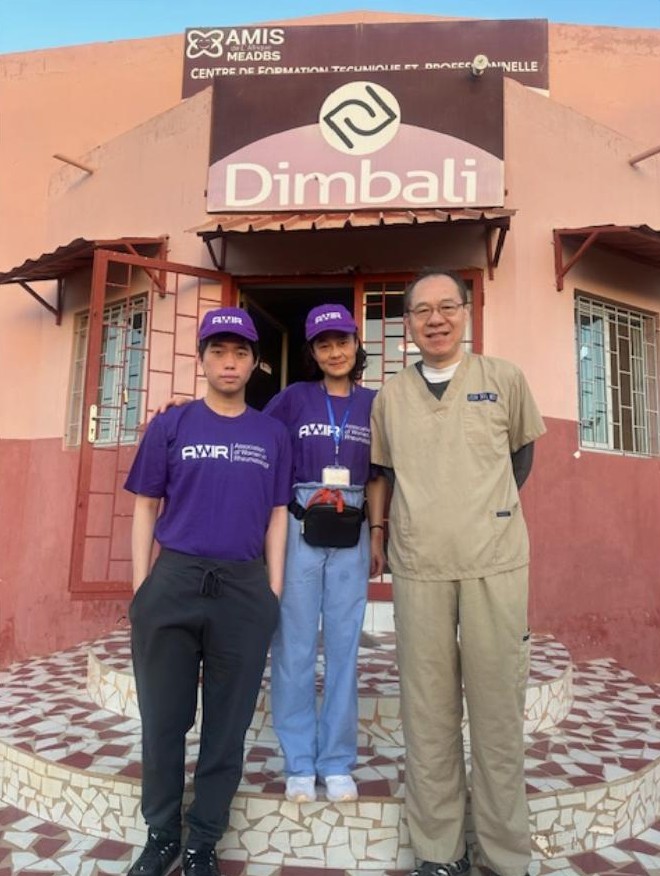 With my Mom and Dr. Jun Xu, Founder of Africa Cries Out Foundation.
About the author:
Tony Lam B.A., University of California, Berkeley
Incoming Medical Student, David Geffen School of Medicine at UCLA (Class of 2029)
********************************************
If you are moved and willing to support our African ministry, please write a check to Africa Cries Out and send it to Jun Xu, MD, 1171 E Putnam Avenue, Riverside, CT06878, USA. You will receive a tax-free receipt recognized by the IRS.
Online Credit Card Donation: https://africacriesout.net/ (credit card company will charge a handling fee)
Zelle: Africacriesout@gmail.com
Our team solemnly declares that 100% of your donation will be used for the people of Africa, and we do not get even a penny of administrative fees.
Jun Xu WeChat: jun9174343767
Email: Africacriesout@gmail.com
Public WeChat account: LifeExploring (人生天路)
Web page: https://africacriesout.net
Editor: Doris Cruz